

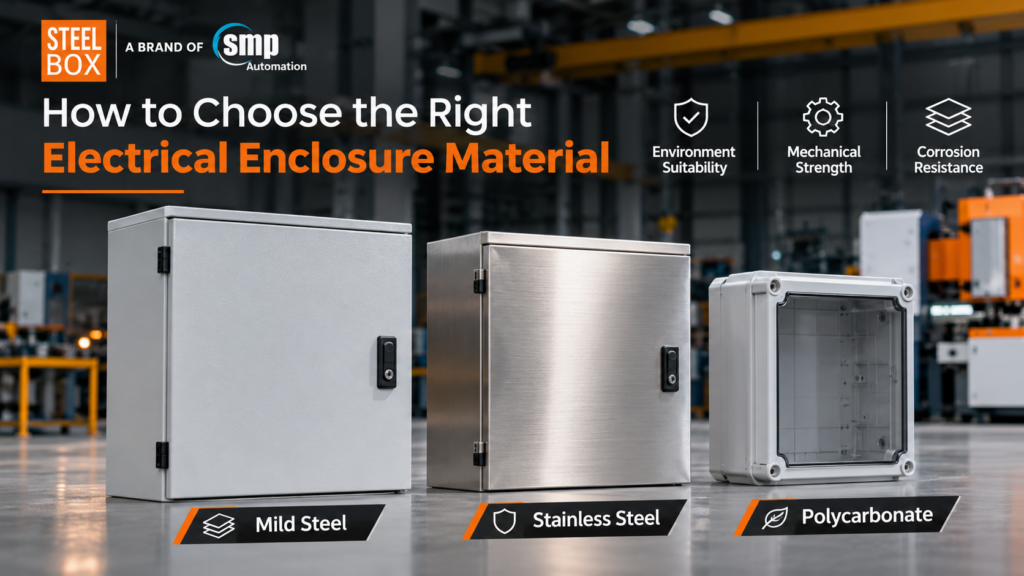
Choosing the right electrical enclosure material is an important part of protecting electrical equipment. The material affects corrosion resistance, mechanical strength, weight, maintenance and suitability for the installation environment.
Mild steel, stainless steel and polycarbonate are commonly used for electrical enclosures. Each has different characteristics, and the right choice depends on where the enclosure will be installed, what it needs to protect and how it will be maintained.
This guide explains the key differences and the factors to consider when selecting an electrical enclosure material.
Why Enclosure Material Matters
An electrical enclosure protects components such as terminals, control equipment, circuit breakers and wiring. Its material should be suitable for the surrounding conditions and the demands of the application.
Consider these factors before selecting a material:
- Corrosion resistance: Is the enclosure exposed to moisture, chemicals or corrosive surroundings?
- Mechanical strength: Could it experience impact, vibration or rough handling?
- Installation environment: Will it be installed indoors, outdoors or in a demanding industrial location?
- Weight: Does the installation have restrictions on the weight of the enclosure?
- Maintenance: How often will the enclosure need inspection, cleaning or surface maintenance?
- Cost: Consider the initial cost along with the expected service life and maintenance requirements.
The material alone does not determine the enclosure’s protection rating. The enclosure design, door seal, joints, cable entries and installation also matter.
Mild Steel Electrical Enclosures
Mild steel is widely used for industrial electrical enclosures because it offers a practical balance of strength, fabrication flexibility and cost.
It can be cut, bent, welded and finished to suit different enclosure sizes and configurations. This makes it suitable for custom sheet-metal enclosure manufacturing.
Advantages
- Good mechanical strength for many industrial applications
- Suitable for custom dimensions and fabricated designs
- Can be finished with protective coatings
- Often a cost-effective option for general industrial use
Considerations
Mild steel can corrode if its protective finish is damaged or unsuitable for the environment. Surface preparation, coating quality, sealing and maintenance should be considered, particularly for outdoor installations.
Mild steel is commonly considered for industrial control equipment, electrical distribution applications and general-purpose fabricated enclosures.
Stainless Steel Electrical Enclosures
Stainless steel is selected when corrosion resistance is an important requirement. Its suitability depends on the stainless-steel grade and the conditions in which the enclosure will be used.
Advantages
- Strong corrosion resistance for suitable grades and environments
- Useful in applications requiring frequent cleaning
- Durable construction
- Suitable for selected demanding industrial environments
Considerations
Stainless steel generally has a higher material cost than mild steel. The correct grade should be selected based on exposure to moisture, chemicals, cleaning agents and other environmental conditions.
Stainless steel may be considered for food-processing areas, pharmaceutical facilities, coastal installations and other locations where corrosion resistance is a priority. The exact grade and enclosure design must match the application.
Polycarbonate Electrical Enclosures
Polycarbonate is a non-metallic material used in certain electrical enclosure applications. It can be useful where low weight or electrical insulation properties are important.
Advantages
- Lightweight compared with many metal enclosures
- Electrically insulating material
- Does not rust
- Available in different sizes and configurations
Considerations
Polycarbonate performance depends on the material formulation and enclosure design. Temperature, ultraviolet exposure, chemical contact and mechanical loads should be reviewed before selection.
Polycarbonate may suit smaller electrical, instrumentation or control applications where its material properties meet the requirements.
Electrical Enclosure Material Comparison
| Feature | Mild Steel | Stainless Steel | Polycarbonate |
|---|---|---|---|
| Mechanical strength | Generally high | Generally high | Depends on design |
| Corrosion resistance | Requires suitable finish | High for suitable grades | Does not rust |
| Weight | Moderate to high | Moderate to high | Generally low |
| Fabrication | Well suited to sheet-metal fabrication | Fabricable, but typically more demanding | Usually moulded |
| Relative material cost | Often lower | Often higher | Varies by type and size |
| Typical consideration | General industrial use | Corrosive or cleaning-intensive environments | Lightweight, insulated applications |
This comparison is general. Actual performance depends on material grade, thickness, construction, finish and installation conditions.
How to Select the Right Material
Use the following steps when evaluating an electrical enclosure:
1. Identify the installation environment
Review indoor or outdoor use, humidity, temperature, dust, water exposure and possible chemical contact.
2. Define the mechanical requirements
Consider enclosure size, mounting method, expected impact and the weight of the equipment inside.
3. Determine the required protection
Specify the required IP rating and any mechanical protection requirements. Confirm that the complete enclosure design—not just the material—meets the intended conditions.
4. Review the finish and maintenance
For metal enclosures, assess the coating or surface finish and the maintenance needed to preserve it. For non-metallic enclosures, review UV and chemical compatibility where relevant.
5. Confirm dimensions and fabrication requirements
Check the required height, width, depth, mounting plate, door arrangement, cable entries and any special fabrication details.
6. Compare total suitability—not just price
The lowest initial cost may not be the best choice if the enclosure requires frequent maintenance or is unsuitable for the installation environment.
Custom Electrical Enclosures from Steel Box India
Steel Box India, a brand of SMP Automation, manufactures custom sheet-metal electrical enclosures for industrial, electrical and automation applications.
Enclosures can be developed around customer drawings, dimensions, specifications and production requirements. Material, thickness, finish, mounting arrangements and other design details should be confirmed against the intended application.
Explore our electrical enclosure products and manufacturing capabilities, or contact Steel Box India to discuss your enclosure requirements.
Frequently Asked Questions
Which material is best for an electrical enclosure?
There is no single best material for every application. Mild steel is often considered for general industrial use, stainless steel for environments where corrosion resistance is important, and polycarbonate for selected lightweight or insulated applications.
Is mild steel suitable for outdoor electrical enclosures?
It can be suitable when the enclosure has an appropriate protective finish, sealing design and rating for the installation environment. The complete enclosure specification should be reviewed.
Does stainless steel always prevent corrosion?
No. Corrosion resistance depends on the stainless-steel grade and the conditions it encounters, including chemicals, salts and cleaning agents.
Does enclosure material determine the IP rating?
No. The IP rating applies to the protection provided by the complete enclosure. Seals, joints, doors, cable entries and installation details all affect performance.
Can electrical enclosures be manufactured to custom dimensions?
Yes. Custom sheet-metal enclosures can be fabricated to customer drawings and specifications, subject to design and manufacturing feasibility.